
Role of Embedded System and its future in industrial automation

Embedded systems have become increasingly important in today’s world of automation. Particularly in the field of industrial automation, embedded systems play an important role in speeding up production and controlling factory systems. In recent years, embedded systems have emerged as an essential component of various industries which is revolutionizing the automation of industrial processes. As a result of the integration of these systems into devices and machinery, manufacturing processes are streamlined, performance is enhanced, and efficiency is optimized. It is predicted in a survey report by market.us that the global embedded system market size will reach USD 173.4 billion by 2032, growing at a CAGR of 6.8% over the forecast period of 2023 to 2032. There is a growing demand for smart electronic devices, the Internet of Things (IoT), and automation across a number of industries that are driving this growth. Embedded systems in industrial automation will be discussed in this article, as well as some promising prospects.

What is the role of embedded systems and why are they essential in industrial automation?

A wide range of benefits and capabilities are provided by embedded systems based applications in the industry. As a result of its real-time control and monitoring capabilities, industries can optimize processes, make informed decisions, and respond swiftly to anomalies as they arise. The productivity and efficiency of embedded systems are improved by automating repetitive tasks and streamlining processes. The embedded system facilitates proactive monitoring, early hazard detection, and effective risk management with a focus on safety and risk management with their incorporation with cutting-edge technologies like AI, ML, and IoT. It also creates new opportunities for advanced analytics, proactive maintenance, and autonomous decision-making.
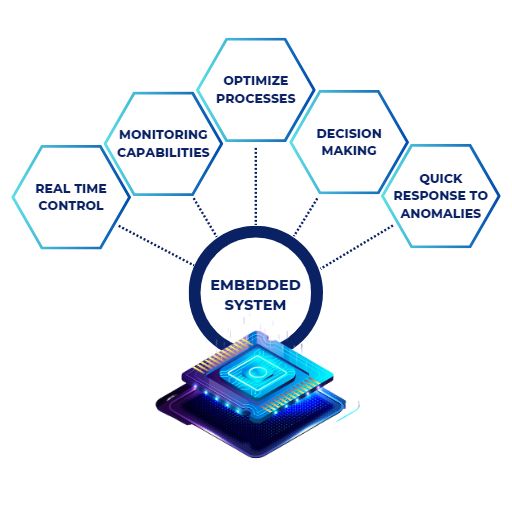
Roles of embedded system in industrial automation

Overall, the embedded system is an indispensable component of industrial automation, driving innovation, and enabling businesses to thrive in a dynamic and competitive landscape.

The industrial automation embedded system is divided into 2 main categories.

1. Machine control: Providing control over various equipment and processes is one of the main uses of embedded systems in industrial automation. With embedded systems serving as the central control point, manufacturing equipment, sensors, and devices can be precisely controlled and coordinated. To control the operation of motors, valves, actuators, and other components, these systems receive input from sensors, process the data, and produce output signals. Embedded systems make it possible for industrial processes to be carried out precisely and efficiently by managing and optimising the control systems. Let’s look at a few machine control use cases.

Manufacturing: Embedded systems are extensively used in manufacturing processes for machine control. They regulate and coordinate the operation of machinery, such as assembly lines, CNC machines, and industrial robots. Embedded systems ensure precise control over factors like speed, position, timing, and synchronization, enabling efficient and accurate production.

Robotics: Embedded systems play a critical role in controlling robotic systems. They govern the movements, actions, and interactions of robots in industries such as automotive manufacturing, warehouse logistics, and healthcare. Embedded systems enable robots to perform tasks like pick and place, welding, packaging, and inspection with high precision and reliability.

Energy management: Embedded systems are employed in energy management systems to monitor and control energy usage in industrial facilities. They regulate power distribution, manage energy consumption, and optimize energy usage based on demand and efficiency. Embedded systems enable businesses to track and analyze energy data, identify energy-saving opportunities, and implement energy conservation measures. These systems continuously monitor various energy consumption parameters, such as power usage, equipment efficiency, and operational patterns. By analysing the collected data, embedded systems can detect patterns and trends that indicate potential energy-saving opportunities.For example, they can identify instances of excessive energy consumption during specific periods or equipment malfunctions that result in energy waste. These insights enable businesses to optimize energy usage and reduce waste.
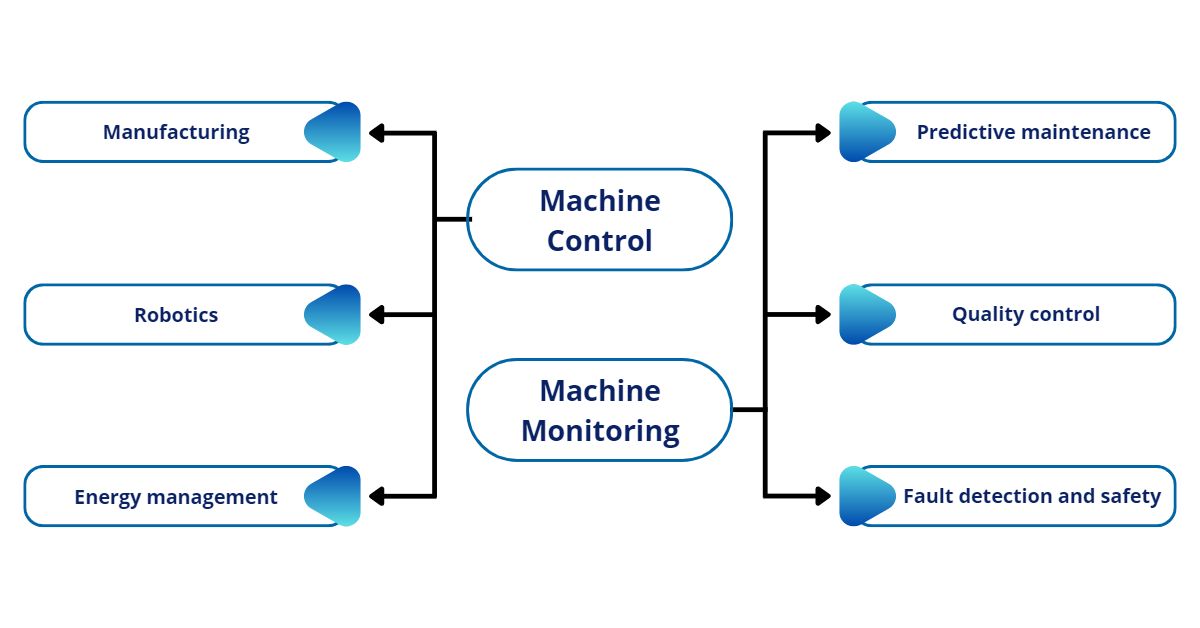
Classes of embedded system in industrial automation

2. Machine monitoring: Embedded systems are also utilized for monitoring in industrial automation. They are equipped with sensors and interfaces that enable the collection of real-time data from different points within the production environment. This data can include information about temperature, pressure, humidity, vibration, and other relevant parameters. Embedded systems process and analyze this data using machine learning and deep learning algorithms, providing valuable insights into the performance, status, and health of equipment and processes. By continuously monitoring critical variables, embedded systems facilitate predictive maintenance, early fault detection, and proactive decision-making, leading to improved reliability, reduced downtime, and enhanced operational efficiency. Some examples of machine monitoring:

Predictive maintenance: Intelligent embedded systems enable real-time monitoring of machine health and performance. By collecting data from sensors embedded within the machinery, these systems can analyze machine parameters such as temperature, vibration, and operating conditions. The collected data is utilized to identify irregularities and anticipate possible malfunctions, enabling proactive maintenance measures and minimizing unexpected downtime.

Quality control: Embedded systems in machine monitoring focus on product quality and consistency during manufacturing. They monitor variables such as pressure, speed, dimensions, and other relevant parameters to maintain consistent quality standards. For example, an embedded system may monitor pressure levels during the injection moulding process to ensure that the produced components meet the required specifications. If the pressure deviates from the acceptable range, the system can trigger an alarm or corrective action to rectify the issue. This will maintain the high standard of product quality.

Fault detection and safety: Machine monitoring systems detect potential faults or unsafe conditions in manufacturing environments. They continuously monitor machine performance and operating conditions to identify deviations from normal operating parameters. For instance, if an abnormal temperature rise is detected in a motor, indicating a potential fault or overheating, the embedded system can trigger an alarm or safety measure. This will prevent further damage or accidents. The focus here is on maintaining a safe working environment and protecting both equipment and personnel.

The Future of Embedded Systems in Industrial Automation
Embedded systems are poised to play a major role in industrial automation as automation demand continues to grow. These systems have the potential to improve efficiency, increase productivity, and drive innovation in industrial processes. Furthermore, the integration of embedded systems with emerging technologies like the Internet of Things (IoT) and Artificial Intelligence (AI) is expected to enhance their capabilities even further. Overall, embedded systems are essential for enabling businesses to thrive in the dynamic and competitive landscape of industrial automation.

Softnautics specializes in providing secure embedded systems, software development, and FPGA design services. We implement the best design practices and carefully select technology stacks to ensure optimal embedded solutions for our clients. Our platform engineering services include FPGA design, platform enablement, firmware and driver development, OS porting and bootloader optimization, middleware integration for embedded systems, and more. We have expertise across various platforms, allowing us to assist businesses in building next-generation systems, solutions, and products.

Read our success stories related to embedded system design to know more about our platform engineering services.

Contact us at business@softnautics.com for any queries related to your solution or for consultancy.

[elementor-template id=”13562″]

Role of Embedded System and its future in industrial automation Read More »

Understanding the Deployment of Deep Learning Algorithms on Embedded Platforms

Understanding the Deployment of Deep Learning Algorithms on Embedded Platforms

Embedded platforms have become an integral part of our daily lives, revolutionizing our technological interaction. These platforms, equipped with deep learning algorithms, have opened a world of possibilities, enabling smart devices, autonomous systems, and intelligent applications. The deployment of deep learning algorithms on embedded platforms is crucial. It involves the process of optimizing and adapting deep learning models to run efficiently on resource-constrained embedded systems such as microcontrollers, FPGAs, and CPUs. This deployment process often requires model compression, quantization, and other techniques to reduce the model size and computational requirements without sacrificing performance.

The global market for embedded systems has experienced rapid expansion, expected to reach USD 170.04 billion in 2023. As per precedence research survey, it is expected to continue its upward trajectory, with estimates projecting it to reach approximately USD 258.6 billion by 2032. The forecasted Compound Annual Growth Rate (CAGR) during the period from 2023 to 2032 is around 4.77%. Several key insights emerge from the market analysis. In 2022, North America emerged as the dominant region, accounting for 51% of the total revenue share, while Asia Pacific held a considerable share of 24%. In terms of hardware platforms, the ASIC segment had a substantial market share of 31.5%, and the microprocessor segment captured 22.3% of the revenue share in 2022.

Embedded platforms have limited memory, processing power, and energy resources compared to traditional computing systems. Therefore, deploying deep learning algorithms on these platforms necessitates careful consideration of hardware constraints and trade-offs between accuracy and resource utilization.

The deployment includes converting the trained deep learning model into a format compatible with the target embedded platform. This involves converting the model to a framework-specific format or optimizing it for specific hardware accelerators or libraries.

Additionally, deploying deep learning algorithms on embedded platforms often involves leveraging hardware acceleration techniques such as GPU acceleration, specialized neural network accelerators, or custom hardware designs like FPGAs or ASICs. These hardware accelerators can significantly enhance the inference speed and energy efficiency of deep learning algorithms on embedded platforms. The deployment of deep learning algorithms on embedded platforms typically includes below.

Deep learning model deployment on various embedded platforms

Optimizing deep learning models for embedded deployment

Deploying deep learning algorithms on embedded platforms requires careful optimization and adaptation. Model compression, quantization, and pruning techniques help reduce the model’s size and computational requirements without compromising performance.

Hardware considerations for embedded deployment

Understanding the unique hardware constraints of embedded platforms is crucial for successful deployment. Factors such as available memory, processing power, and energy limitations needs to be carefully analysed. Selecting deep learning models and architectures that effectively utilize the resources of the target embedded platform is essential for optimal performance and efficiency.

Converting and adapting models for embedded systems

Converting trained deep learning models into formats compatible with embedded platforms is a critical step in the deployment process. Framework-specific formats such as TensorFlow Lite or ONNX are commonly used. Additionally, adapting models to leverage specialized hardware accelerators, like GPUs, neural network accelerators, or custom designs such as FPGAs or ASICs, can significantly enhance inference speed and energy efficiency on embedded platforms.

Real-time performance and latency constraints

In the domain of embedded systems, real-time performance and low latency are crucial. Deep learning algorithms must meet the timing requirements of specific applications, ensuring prompt and efficient execution of the inference process. Balancing real-time demands with the limited resources of embedded platforms requires careful optimization and fine-tuning.

If the deployed model doesn’t meet the desired performance or resource constraints, an iterative refinement process may be necessary. This could involve further model optimization, hardware tuning, or algorithmic changes to improve the performance or efficiency of the deployed deep learning algorithm.

Throughout the deployment process, it is important to consider factors such as real-time requirements, latency constraints, and the specific needs of the application to ensure that the deployed deep learning algorithm functions effectively on the embedded platform.

Frameworks and tools for deploying deep learning algorithms

Several frameworks and tools have emerged to facilitate the deployment of deep learning algorithms on embedded platforms. TensorFlow Lite, PyTorch Mobile, Caffe2, OpenVINO, and ARM CMSIS-NN library are among the popular choices, providing optimized libraries and runtime environments for efficient execution on embedded devices.

Let us see a few use cases where deep learning model deployment on embedded edge platforms is suitable.

  • Autonomous Vehicles: Autonomous vehicles rely heavily on computer vision algorithms trained using deep learning techniques such as Convolutional Neural Networks (CNNs) or Recurrent Neural Networks (RNNs). These systems process images from cameras mounted on autonomous cars to detect objects like pedestrians crossing streets, parked cars along curbsides, cyclists riding, etc. based on which the autonomous vehicle perform actions.
  • Healthcare and Remote Monitoring: Healthcare: Deep learning is rapidly gaining traction in the healthcare industry. For instance, wearable sensors and devices utilize patient data to offer real-time insights into various health metrics, including overall health status, blood sugar levels, blood pressure, heart rate, and more. These technologies leverage deep learning algorithms to analyze and interpret the collected data, providing valuable information for monitoring and managing patient conditions.

Future trends and advancements

The future holds exciting advancements in deploying deep learning algorithms on embedded platforms, edge computing, with AI at the edge, enables real-time decision-making and reduced latency. The integration of deep learning with Internet of Things (IoT) devices further extends the possibilities of embedded AI. Custom hardware designs tailored for deep learning algorithms on embedded platforms are also anticipated, offering enhanced efficiency and performance.

Deploying deep learning algorithms on embedded platforms involves a structured process that optimizes models, considers hardware constraints, and addresses real-time performance requirements. By following this process, businesses can harness the power of AI on resource-constrained systems, driving innovation, streamlining operations, and delivering exceptional products and services. Embracing this technology empowers businesses to unlock new possibilities, leading to sustainable growth and success in today’s AI-driven world.

Furthermore, real-time performance requirements and latency constraints are critical considerations in deploying deep learning algorithms on embedded platforms, on which the efficient execution of the inference process depends.

At Softnautics, our team of AI/ML experts specializes in developing optimized Machine Learning solutions tailored for a wide range of edge platforms. Our expertise spans FPGA, ASIC, CPUs, GPUs, TPUs, and neural network compilers, ensuring efficient and high-performance implementations. Additionally, we also provide platform engineering services to design and develop secure embedded systems aligned with the best design methodologies and technology stacks. Whether it’s building cloud-based or edge-based AI/ML solutions, we are dedicated to helping businesses achieve exceptional performance and value.

Read our success stories related to Machine Learning expertise to know more about our services for accelerated AI solutions.

Contact us at business@softnautics.com for any queries related to your solution or for consultancy.

[elementor-template id=”13562″]

Understanding the Deployment of Deep Learning Algorithms on Embedded Platforms Read More »

An Outline of the Semiconductor Chip Design Flow

An Outline of the Semiconductor Chip Design Flow

Designing a chip is a complex and multi-step process that encompasses various stages, right from initial system specifications to manufacturing. Each step is crucial to achieving the ultimate objective of developing a fully functional chip. In this article, we will provide a brief overview of the chip design flow, its different stages and how they contribute to creating an effective chip. The stages include system specifications, architectural design, functional design, logic design, circuit design, physical design verification, and manufacturing.

The first step in any new development is to decide what kind of device/product will be designed, whether it is an integrated circuit (IC), ASIC, FPGA, SoC, etc. For example, if you want something small but powerful enough for high-speed applications such as telecommunications or networking equipment; then your best option would probably be an Application-Specific Integrated Circuit (ASIC). If you’re looking for something more flexible so that it can perform multiple tasks without much overhead; then maybe an FPGA would work better. Once this is decided, then the specifications can be defined.

Concept of chip design

A chip is a small electronic device that is programmed to perform a specific function. These devices are used in various applications, including computers and cell phones. VLSI technology has revolutionized the electronics industry by enabling designers to integrate millions or even billions of transistors onto a single chip. This has led to the development of powerful processors, memory devices, and other advanced electronic systems.

Chips are designed using different types of technology depending on their application requirements. Let us look into the flow of the entire chip design process.

System specification and architectural design
The first step in the chip design flow is to define the requirements and specifications of the chip. This includes defining what your product will do, how it will be used, and what performance metrics you need to meet. Once these requirements are defined, they can be used as input into designing your architecture and layout.

The next step in chip design after establishing the requirements is to create an architecture that meets them while keeping costs and power consumption to a minimum, among other considerations. During the initial phase of chip design, designers make crucial decisions about the architecture, such as choosing between RISC (Reduced Instruction Set Computer) or CISC (Complex Instruction Set Computer), determining the number of ALUs (Arithmetic Logic Units) required, deciding on the structure and number of pipelines, selecting cache size, and other factors. These choices form the foundation of the rest of the design process, so it is vital that designers carefully evaluate each aspect and consider how it will impact the chip’s overall efficiency and performance. These decisions are based on the chip’s intended use and defined requirements, with the ultimate goal of creating a design that is efficient and effective while minimizing power consumption and costs. After completing the architectural design phase, designers create a Micro-Architectural Specification (MAS), which is a written description of the chip’s architecture. This specification allows designers to accurately predict the design’s performance, power consumption, and die size. By creating a comprehensive MAS, designers can ensure that the chip meets the requirements and specifications established during the initial design phase. A thorough MAS is critical to avoid errors later in the process and to ensure that the chip design meets the required performance standards and timelines. This may involve choosing between different processor types or FPGAs (Field-Programmable Gate Arrays).

Chip Design Flow

Functional design
Next in the process is functional design. It involves defining the functionality and behavior of the chip. This includes creating a high-level description of the system’s requirements and designing the algorithms and data flow needed to meet those requirements. The goal of this stage is to create a functional specification that can be used as a blueprint for the rest of the design process.

Logic design
This step involves the creation of the digital logic circuits required to implement the functionality defined in the functional design stage. This stage includes creating a logical design using a hardware description language (HDL) and verifying the design’s correctness using simulations.

Circuit design
This stage involves designing the physical circuitry of the chip, including the selection of transistors, resistors, capacitors, and other components. The circuit design stage also involves designing the power supply and clock distribution networks for the chip.

Physical design verification
Physical design verification is the process of checking the physical layout of a chip. This involves identifying any design issues and ensuring that the chip will be manufactured correctly. In this step, design of integrated circuit layout is verified via EDA software tools like logic simulators, logic analyzers, etc. and various techniques such as Design Rule Check (DRC), Layout versus Schematic (LVS), and timing and power analysis to ensure correct electrical and logical functionality and manufacturability.

Verification and validation
Once you have completed the design of your chip, it is time to test it. This is called verification and validation (V&V). V&V involves testing the chip using various emulation and simulation platforms to ensure that it meets all the requirements and functions correctly. If there are any errors in the design, it will show up during this stage of development. Validation also helps identify the functional correctness of few initially manufactured prototypes.

At last is the fabrication of physical layout design. After the chip is designed and verified, a .GDS file is sent to foundry for fabrication.

Each stage of the chip design flow is critical to creating a successful and functional chip. By understanding the requirements of each stage, chip designers can create efficient, reliable, and cost-effective designs that meet the need of their customers across various industrial domains.

Future of chip design
The future of chip design is exciting and rapidly evolving, as technology advances. Next-gen chipsets enable new-age solutions by offering higher performance, lower power consumption, and increased functionality. These advancements drive innovation across many industries. One example of next-gen chipsets enabling new-age solutions is Artificial Intelligence (AI) and Machine Learning (ML) applications. AI and ML require significant computational power, which is possible with advanced chipsets. These technologies are used to create autonomous vehicles, personalized healthcare solutions, and advanced robotics, among others.

Another area where next-gen chipsets are making a significant impact is the Internet of Things (IoT) space. The proliferation of connected devices requires powerful, energy-efficient, and cost-effective chipsets to enable communication and data processing across a wide range of devices. Next-gen chipsets are also driving advancements in 5G networks, which are expected to deliver high-speed, low-latency connectivity and unlock new possibilities in areas such as virtual reality, augmented reality, and remote surgery.

The future of chip design is bright, and next-gen chipsets will enable more innovative solutions across many industries. As technology evolves, we can expect even more exciting developments in chip design and the solutions they enable.

To summarize, the chip design process is a complex one that involves many steps and stages. The impact of this on the industry is significant. There are many different types of chips in use today. With new technologies being developed all the time, there will always be room for improvement in terms of how we build these chipsets.

At Softnautics, with our semiconductor engineering services, we help silicon manufacturers in the chip design at any given stage by following best practices. We empower businesses with exceptional ASIC/FPGA platforms, tailored products and solutions, and highly optimized embedded systems. Our core competencies include RTL front-end design and integration, micro-architecture design, synthesis and optimization, IP/SoC level verification and pre/post validation. We also provide VLSI IPs for security, USB, and encryption.

Read our success stories related to the semiconductor industry to know more about our high-performance silicon services.

Contact us at business@softnautics.com for any queries related to your solution design or for consultancy.

[elementor-template id=”13562″]

An Outline of the Semiconductor Chip Design Flow Read More »

An Industrial Overview of Open Standards for Embedded Vision and Inferencing (2)

An Industrial Overview of Open Standards for Embedded Vision and Inferencing

Embedded Vision and Inferencing are two critical technologies for many modern devices such as drones, autonomous cars, industrial robots, etc. Embedded vision uses computer vision to process images, video, and other visual data, while inferencing is the process of making decisions based on collected data without having to explicitly program each decision step with the help of diverse architectures and platforms including multi-core ARM, DSP, GPUs, and FPGAs to provide a comprehensive foundation for developing multimedia systems. Open standards are essential to the development of interoperable systems, and they allow for transparency in the development process while providing a level playing field for all participants.

The global market for embedded vision and inferencing was valued at USD 11.22 billion in 2021, with a compound annual growth rate (CAGR) of around 7% from 2022 to 2030. It’s worth noting that the market share for embedded vision and inferencing is likely to continue evolving rapidly as these technologies are becoming increasingly pivotal for next-gen solutions across industries.

Adoption of Open Standards

Open Standards have been widely adopted by the industry, with many companies adopting them as their default. The benefits of open standards are numerous and include:

  • Reduced cost for development and integration
  • Increased interoperability between systems and components
  • Reduced time to market

Open Standards for Embedded Vision

Open standards for embedded vision are a critical component of the Internet of Things (IoT). They provide a common language that allows devices to communicate with each other, regardless of manufacturer or operating system. Open standards for embedded vision include OpenCV, OpenVX, and OpenCL.

OpenCV is a popular open-source computer vision library that includes over 2,500 optimized algorithms for image and video analysis. It is used in applications such as object recognition, facial recognition, and motion tracking. OpenVX is an open-standard API for computer vision that enables performance and power-optimized implementation, reducing development time and cost. It provides a common set of high-level abstractions for applications to access hardware acceleration for vision processing. OpenCL is an open standard for parallel programming across CPUs, GPUs, and other processors that provides a unified programming model for developing high-performance applications. It enables developers to write code that can run on a variety of devices, making it a popular choice for embedded vision applications.

Open Standards for Embedded Vision & Inferencing

Open Standards for Inferencing

Open standards for inferencing are also essential for the development of intelligent systems. One of the most important open standards is the Open Neural Network Exchange (ONNX), which describes how deep learning models can be exported and imported between frameworks. It is currently supported by major frameworks like TensorFlow, PyTorch, and Caffe2.

ONNX enables interoperability between deep learning frameworks and inference engines, which is critical for the development of intelligent systems that can make decisions based on collected data. It provides a common format for representing deep learning models, making it easier for developers to build and deploy models across different platforms and devices.

Another important open standard for inferencing is the Neural Network Exchange Format (NNEF), which enables interoperability between deep learning frameworks and inference engines. It provides a common format for deploying and executing trained neural networks on various devices. It allows developers to build models using their framework of choice and deploy them to a variety of devices, making it easier to build intelligent systems that can make decisions based on collected data.

Future of Open Standards

The future of open standards for embedded vision and inferencing is bright, but there are challenges ahead. One of the biggest challenges is the lack of support for open-source software in embedded systems. This means that open-source libraries and frameworks cannot be used on devices with limited memory and processing power. Another challenge is the wide variety of processors and operating systems available, making it difficult to create a standard that works across all devices. However, there are initiatives underway like hardware innovation and algorithm optimization to address these challenges.

Industry Impact of Open Standards

Open standards have a significant impact on the industry and consumers. The use of open standards has enabled an ecosystem to develop around machine learning and deep learning algorithms, which is essential for innovation in this space. Open-source software has been instrumental in accelerating the adoption of AI across industries, including automotive, consumer, financial services, manufacturing, and healthcare.

Open standards also have a direct impact on consumers by lowering costs, increasing interoperability, and improving security across devices. For example, standards enable companies to build products using fewer components than proprietary solutions require, reducing costs for manufacturers and end-users who purchase products with embedded vision technology built-in (e.g., cameras).

Open Standards are the key to unlocking the full potential of embedded vision and inferencing. They allow developers to focus on their applications, rather than on the underlying hardware or software platforms. Open standards also provide a level playing field for all types of companies – from startup to large enterprises – to compete in this growing market. Overall, open standards are crucial for unlocking the full potential of embedded vision and inferencing for designing next-gen solutions across various industries.

At Softnautics, we help business across various industries to design embedded multimedia solutions based on next-gen technologies like computer vision, deep learning, cognitive computing and more. We also have hands-on experience in designing high-performance media applications, architect complete video pipelines, audio/video codecs engineering, applications porting, ML model design, train, optimize, test, and deploy.

Read our success stories related to intelligent media solutions to know more about our multimedia engineering services.

Contact us at business@softnautics.com for your solution design or consultancy.

[elementor-template id=”13562″]

An Industrial Overview of Open Standards for Embedded Vision and Inferencing Read More »

Video analytics

Applications and Opportunities for Video Analytics

In recent years, the development of video analytics based video solutions have come up as a high-end technology that has changed the way we interpret and analyze video data. Video analytics uses the most advanced algorithms and artificial intelligence (AI) to track the behaviour and understand the data in real-time, allowing to automate necessary actions. This technology has found many applications across different industries, providing valuable insights, intensifying security, improving the safety and optimizing operations. According to Verified Market Research group, video analytics is experiencing rapid market growth, with its global market value to reach USD 35.88 billion by 2030, representing a CAGR of 21.5% from its valuation of USD 5.65 billion in 2021. This growth trend highlights the increasing demand for video analytics solutions as organizations seek to enhance their security and surveillance systems. 

Video analytics is closely related to video processing which is an essential part of any multimedia solution, as it involves the extraction of meaningful insights and information from video data using various computational techniques. Video analytics leverages the capabilities of video processing to analyze and interpret video content, enabling computers to automatically detect, track, and understand objects, events, and patterns within video streams. Video processing techniques are used in a wide range of applications, including surveillance, video streaming, multimedia communication, autonomous vehicles, medical imaging, entertainment, virtual reality, and many more.

In this article, we will see some Industrial applications and use cases of video analytics in different areas.

Industrial Applications of Video Analytics
Automotive
One of the most used and inescapable uses of video analytics is in the automotive industry for Advanced Driver Assistance System (ADAS) in highly-automate vehicles (HAVs). The HAVs use multiple cameras to identify pedestrians, traffic signals, other vehicles, lanes, and other indicators, they are integrated with the ECU and programmed in such a way as to identify the real-time situation and then respond accordingly. Automating this process, requires integration of various system on a chip (SoC). These chipsets help actuators to connect with the sensors through interface and ECUs. It analyses the data with deep learning based machine learning (ML) models that uses neural networks to learn patterns in data. Neural networks are structured with layers of interconnected processing nodes, typically comprising multiple layers. This deep learning algorithms are used to detect and track objects in real-time videos, as well as to recognize specific actions. 

Sports
In the sports industry, video analytics is being utilized by coaches, personal trainers, and professional athletes to optimize performance through data-driven insights. In sports such as rugby and soccer, tracking metrics like ball possession and the number of passes has become a standard practice for understanding game patterns and team performance. Detailed research on a soccer game has shown that analyzing ball possession can even impact the outcome of a match. Video analytics can be used to gain insights into the playing style, strategies, passing patterns, and weaknesses of the opponent team, enabling a better understanding of their gameplay.

Video Analytics Applications

Retail
Intelligent video analytics is a valuable tool for retailers to monitor storefront events and promptly respond to improve the customer experience. Real-time video is captured by cameras, which cover areas such as shelf inventory, curbside pickup, and cashier queues. On-site IoT Edge devices analyze the video data in real-time to detect key metrics, such as the number of people in checkout queues, empty shelf space, or cars in the parking lot.

Anomaly events can be avoided by metrics analysis, alerting store managers or stock supervisors to take corrective actions. Additionally, video clips or events can be stored in the cloud for long-term trend analysis, providing valuable insights for future decision-making.

Health Care
Video analytics has emerged as a transformative technology in the field of healthcare, offering significant benefits in patient care and operational efficiency. By utilizing cutting-edge machine learning algorithms and computer vision, these systems can analyze video data in real-time to automatically detect and interpret various diseases into human body. It can also be leveraged for patient monitoring, detecting emergencies, identifying wandering behaviour in dementia patients, and analyzing crowd behaviour in waiting areas. These capabilities enable healthcare providers to proactively address potential issues, optimize resource allocation, and enhance patient safety, leading to improved patient outcomes and a higher quality of care. With ongoing advancements in technology, video analytics is poised to play a crucial role in shaping the future of healthcare, making it more intelligent, efficient, and patient-centric.

To summarize, video analytics is a rapidly growing field that leverages various technologies such as computer vision, deep learning, image and video processing, motion detection and tracking, and data analysis to extract valuable insights. Video analytics has found applications in diverse domains, including security and surveillance, healthcare, automotive, sports, and others. By automating the analysis of video data, video analytics enables organizations to efficiently process large amounts of visual information, identify patterns and behaviours, and make data-driven decisions in more effective and less expensive.

With continuous advancements in technology, we at Softnautics help businesses across various industries to provide intelligent media solutions involving the simplest to the most complex multimedia technologies. We have hands-on experience in designing high-performance media applications, architect complete video pipelines, audio/video codecs engineering, applications porting, ML model design, optimize, test and deploy.

We hope you enjoyed this article and got a better understanding of how video analytics based intelligent solutions can be implemented for various businesses to automate processes, improve efficiency/accuracy, and take better decisions.

Read our success stories related to intelligent media solutions to know more about our multimedia engineering services.

Contact us at business@softnautics.com for any queries related to your solution or for consultancy.

[elementor-template id=”13562″]


Applications and Opportunities for Video Analytics Read More »

Scroll to Top